
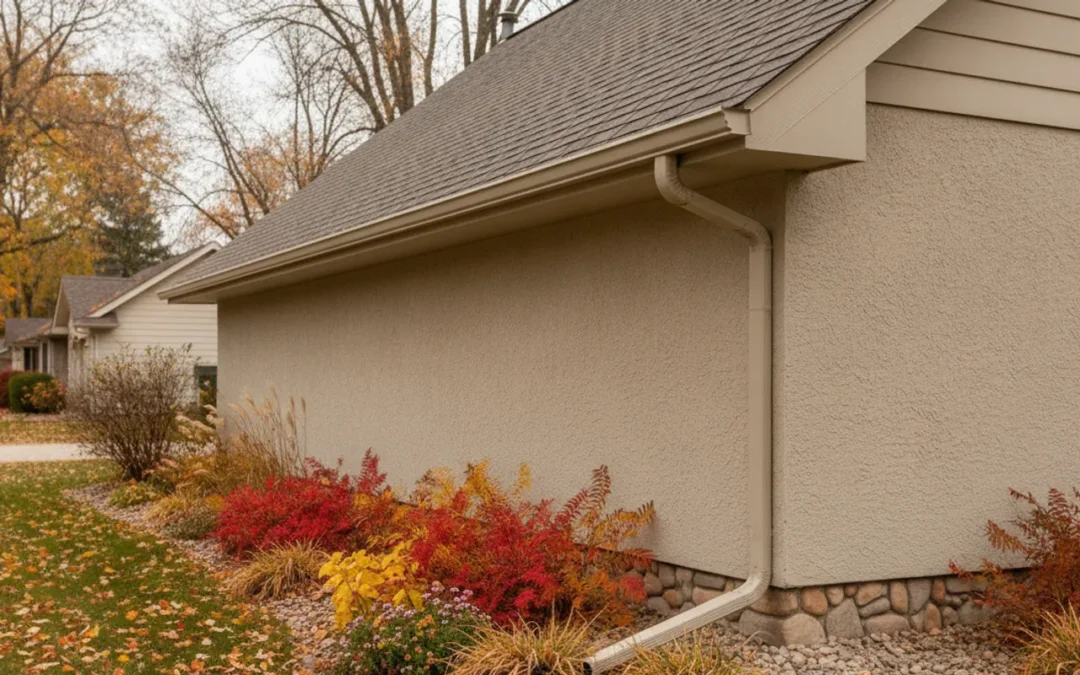
For many homeowners comparing seamless gutters Flint MI options, the main appeal is a gutter system made to fit the home instead of assembled from multiple short sections along each run. A seamless system can be worth considering when you want a clean, continuous appearance and a plan tailored to the roofline, but the fit, drainage layout, materials, and estimate matter just as much as the word “seamless.”
Signature Home Pros serves central Michigan homeowners with exterior renovation services and custom seamless aluminum gutter installation. This guide focuses on the decision a Flint-area homeowner needs to make: whether a seamless system suits the house and how to evaluate the proposed scope. It is not a price list or a promise that one gutter style works for every roof.
What does “seamless gutters” mean?
Traditional sectional gutters are assembled from shorter lengths joined together along a roof edge. A seamless system is formed to the needed length for each gutter run, reducing the number of joints along that run. Corners, end caps, outlets, and downspout connections still need to be addressed; “seamless” does not mean the entire system has no connections or openings.
Signature Home Pros describes its gutter service as custom seamless aluminum installation with on-site fabrication. The practical point for a homeowner is that the gutter run is planned around the home rather than selected only by a standard pre-cut length. Ask how the contractor will account for the shape of the roofline, corners, outlets, and locations where water should discharge.
Seamless gutters are one option, not an automatic solution to every drainage issue. The condition of the roof edge, the shape of the house, the path water takes after it leaves the downspout, and any existing problems should all be part of the conversation. A new gutter alone cannot resolve every cause of dampness or drainage trouble around a home.
Why might a Flint homeowner consider seamless gutters?
Homeowners usually compare seamless systems for a combination of appearance, fit, and upkeep. With fewer joints along a straight run than a sectional system, there are fewer seams in that portion of the gutter to inspect. A continuous line can also create a simple, finished look along the eaves. These are useful considerations, but they do not remove the need for routine checks and appropriate drainage planning.
- A more continuous roofline: Fewer visible joints can give the gutter edge a cleaner appearance.
- A custom fit: Each run can be planned for the home’s dimensions and configuration.
- Material choice: Aluminum is a common option, and Signature Home Pros offers custom seamless aluminum gutters.
- A chance to review drainage: A project discussion can include where downspouts are located and where the water goes after discharge.
These advantages depend on the design and workmanship of the specific project. A seamless gutter that does not fit the roofline well, or a system that sends water to an unsuitable spot, is not a good result just because it has fewer joints.
How do you decide whether seamless gutters fit your home?
Start by looking at the current system and identifying what you want to improve. Is the concern visible sagging, separated joints, water spilling over during rain, an awkward appearance, or uncertainty about where downspouts release water? Be specific. A contractor can then assess whether the gutter itself, its layout, or another part of the exterior drainage picture needs attention.
Consider the roofline and its transitions
Walk around the house from the ground and note the different roof edges, inside or outside corners, and places where roof sections meet. Complex rooflines may require more planning than a long, straight run. Do not climb onto the roof to inspect the system. Instead, share what you have observed and ask the contractor to explain how the proposed layout handles each transition.
Think about where water should go
Gutters collect water from the roof and direct it to downspouts. The downspout location and discharge path deserve attention alongside the gutter itself. Ask where each outlet is planned and how the estimate accounts for the route water will take away from the house. If you have noticed pooling or recurring wet areas, point those out. The contractor should clarify what is included in the gutter scope and what may require separate evaluation. For broader information about Michigan water resources and stormwater, homeowners can consult the Michigan Department of Environment, Great Lakes, and Energy.
Be clear about appearance and upkeep
Color, visibility from the street, and how the system relates to the trim can affect your choice. Ask to review available material and finish options for your project. Also discuss how to inspect and maintain the system after installation. No gutter style should be treated as maintenance-free, and a homeowner’s access and comfort with routine checks may influence what feels practical.
What should you compare before choosing a gutter option?
The table below is a starting point for a project conversation. It compares general approaches rather than predicting what any particular home needs. Actual suitability depends on the roofline, existing system, and the contractor’s assessment.
| Option | How it is assembled | What to consider | Useful estimate question |
|---|---|---|---|
| Custom seamless aluminum | Runs are made to the needed length, with connections at corners and other system points. | Fewer joints along a straight run; confirm material, finish, layout, outlets, and downspouts. | How will the proposed runs and discharge points fit my roofline? |
| Sectional gutters | Shorter lengths are joined together to create a run. | Review the number and placement of joints, condition, and how the system fits the home. | Which joints or sections are included, and what is excluded? |
| Repair of an existing system | Selected areas are addressed while much of the existing gutter may remain. | Ask whether the existing system is suitable to retain and what the repair is intended to resolve. | What condition did you observe, and what does this repair cover? |
Do not compare proposals by a single label. One estimate may include a different length, number of corners, downspout arrangement, or removal scope than another. Ask each contractor to describe the same parts of the project so you can make a fair comparison.
What should a seamless gutter estimate explain?
A clear estimate should let you understand the proposed work before you agree to it. The details matter because “new gutters” can describe different scopes. Read the document and ask for clarification on any line that is vague or missing.
- Areas covered: Which roof edges or gutter runs are included? Are any sections being left in place?
- Material and finish: What gutter material and finish are proposed, and what choices are available?
- Layout: How are corners, outlets, and downspouts addressed? Where will downspouts discharge?
- Removal and cleanup: Does the scope say whether existing gutters will be removed and how debris will be handled?
- Site-specific considerations: Are there visible roof-edge, fascia, or access concerns that affect the proposal? Ask what is included and what would need separate approval.
- Schedule and communication: What is the expected next step, and who should you contact with questions about the work?
- Written terms: Review payment terms, any applicable warranty language, and the process for approving changes. Do not assume a term that is not written down.
For homeowners comparing exterior work together, it may also help to understand how the gutter scope relates to the rest of the roof edge. Signature Home Pros provides roofing services and siding installation, as well as stone installation. Each service has its own scope; ask whether any planned work needs to be coordinated rather than assuming it is automatically included with gutters.
Use a like-for-like comparison
Before weighing two proposals, write down the same basic checklist for each: which runs are being replaced, whether existing material is removed, the gutter material and finish, downspout count and placement, and any stated exclusions. If one contractor proposes retaining a section while another includes a full replacement, the totals are not describing the same work. Ask what condition supports the difference and whether both options are practical for the home.
For example, imagine one estimate lists new gutters but says little about downspouts, while another identifies the included runs and discharge locations. The second document is easier to evaluate, even before comparing the final price. If details are missing, request a written clarification instead of filling in the gaps yourself. This simple step can prevent mismatched expectations about what the project will address.
Which questions help you compare contractors?
Choose questions that prompt a specific explanation of your home, not just a general sales pitch. You can use this list during an estimate visit or when reviewing written proposals:
- What did you observe about the current gutter system and the roofline?
- Which runs are included in the proposal, and are any being excluded?
- How will the proposed layout handle corners, outlets, and downspouts?
- Where will the water discharge, and what should I watch for after the work?
- What material and finish are included, and what alternatives can I consider?
- Does the proposal include removal of the existing system and cleanup?
- What conditions are outside the quoted scope, and how would additional work be discussed?
- Can you provide the project terms and any warranty details in writing?
Look for answers that connect to the details of your home. If a proposal uses broad wording, ask for a written explanation before making a decision. A no-pressure discussion gives you room to review the scope and decide whether it fits your priorities.
How can you prepare for an estimate?
A little preparation can make the conversation more useful. Make a short list of what you have noticed: where water appears to overflow, whether a gutter looks loose or separated, and any areas around the home where water seems to collect. These observations help frame the discussion, but they are not a substitute for an on-site assessment.
Take photos from the ground if they can be made safely. Note which side of the house each photo shows and what you saw during or after rainfall. Gather any previous proposals or records of gutter work if available. If the project is part of a larger exterior update, mention that early so the contractor can discuss whether the timing or scope needs coordination.
It can also help to decide what matters most to you: a particular appearance, replacing a visibly worn system, clarifying where water is routed, or addressing several exterior needs together. You do not need to know the technical answer in advance. The goal is to explain your concerns and ask for a proposal that addresses them clearly.
Make a simple ground-level observation log
If the issue is intermittent, a few observations can make your estimate discussion more concrete. After rainfall, note the date, the side of the home, and what you noticed. Did water spill over one area, appear to run behind a gutter, or discharge near a spot that already stays wet? Record only what you can see safely from the ground; do not use a ladder or reach over an edge to inspect a gutter.
Keep the notes descriptive rather than diagnostic. “Water pooled by the rear downspout after rain” is more useful than guessing that a particular component is defective. If you take photographs, capture enough of the surrounding roof edge to show the location, and label the side of the house. This gives the contractor a clearer starting point while leaving the assessment to the on-site review.
Decide what a successful outcome means to you
Homeowners may have different priorities even when looking at similar houses. One person may care most about replacing visibly worn sections; another may want to understand where runoff goes or choose a finish that blends with trim. Rank your priorities before the estimate. Then ask which parts of the proposal address each one and which concerns, if any, are outside its scope.
This is also a good time to flag practical constraints, such as a side yard where access is limited or an area where you have noticed recurring water. You are not expected to design the gutter system. Sharing observations and priorities helps the contractor explain the available options in terms you can compare.
Explore seamless gutter services
How do gutters relate to the rest of the exterior?
Gutters sit at the edge of a larger exterior system. Roof condition, siding, trim, and the route water takes after it leaves a downspout can all be relevant to the homeowner’s observations. That does not mean gutter work automatically includes repairs to those other components. Ask the contractor to identify what is within the estimate and what would be a separate project.
If you are considering more than one exterior improvement, you can review the company’s home exterior renovation services and learn about the family-owned business on its About Us page. Homeowners in Flint and nearby communities can also check the service area information to see the areas served. These pages can help you understand the company’s service scope; your estimate should still spell out the specific work proposed for your home.
Ready to discuss seamless gutters in Flint?
If you are deciding between replacing, repairing, or changing the layout of your gutters, start with an assessment of the actual home and a written scope you can compare. Signature Home Pros offers custom seamless aluminum gutter installation and serves central Michigan homeowners. A conversation can help clarify the options without requiring you to settle every detail before asking questions.
Book a consultation to discuss your project or call Signature Home Pros at (810) 270-5922.
Frequently asked questions
Are seamless gutters completely joint-free?
No. The long gutter runs have fewer joints than a system assembled from multiple short sections, but connections are still needed at corners, end caps, outlets, and downspouts. Ask how those points are handled in the proposed layout.
Are seamless aluminum gutters a good fit for every Flint home?
Not automatically. The roofline, existing gutter condition, drainage concerns, and homeowner priorities should guide the decision. Ask a contractor to assess the home and explain why the proposed system fits its specific layout.
Can seamless gutters solve water problems around the foundation?
Gutters and downspouts help collect and route roof runoff, but a new gutter system alone may not resolve every source of water around a home. Explain where you see water and ask what the estimate addresses, including the planned downspout discharge locations.
What should I compare between gutter estimates?
Compare the included runs, material and finish, corners, outlets, downspouts, removal, cleanup, written terms, and any stated exclusions. Ask each contractor to clarify differences so you are comparing similar scopes rather than only the headline description.
Does Signature Home Pros install seamless gutters in Flint, MI?
Signature Home Pros offers custom seamless aluminum gutter installation and serves central Michigan homeowners. Contact the company to discuss your home, confirm service availability for your address, and request an estimate.
With a clear understanding of the roofline, water path, and written scope, you can decide whether seamless gutters are the right next step for your Flint-area home.
Recent Comments