
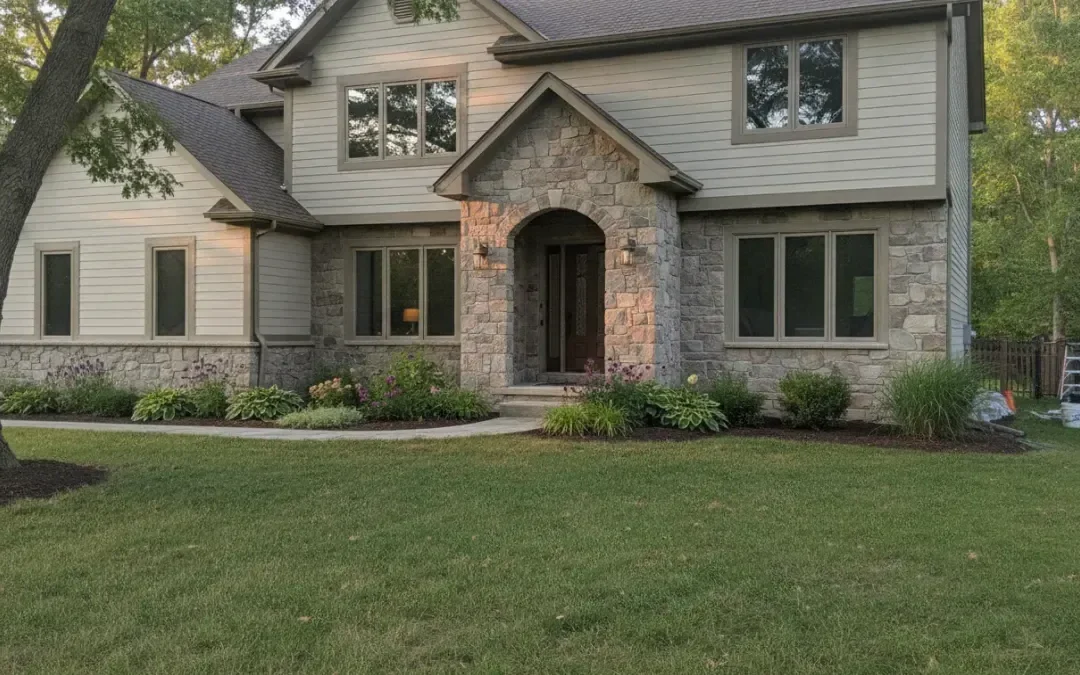
When Michigan homeowners search for stone veneer installation cost Michigan, they are usually trying to set a realistic budget before choosing a material or requesting estimates. The honest answer is that there is no single price for every home. The surface area, veneer type, wall condition, number of corners and openings, access, and moisture-management details can change the scope substantially. This guide explains what belongs in a stone veneer budget and links to Signature Home Pros’ Michigan gutters, gutter guards, and stone veneer installation guide for broader exterior planning context.
What Is the Average Stone Veneer Installation Cost in Michigan?
Short answer: Stone veneer installation cost in Michigan is project-specific, so a responsible estimate should be based on measured square footage and a review of the wall assembly rather than a generic statewide average. A small entry accent and a full multi-story facade may use the same product family but require very different amounts of material preparation, labor, trim, access, and cleanup.
Homeowners often see a per-square-foot figure in online cost guides. That figure can be useful for comparing the relative scale of options, but it is not a quote unless the scope behind it is clear. Ask whether a published figure includes the veneer, corners, mortar, lath or approved backing, flashing, demolition, substrate repair, scaffolding, installation labor, disposal, and final cleanup. A low number that excludes several of those items is not directly comparable with a complete proposal.
For a Michigan home, the first budgeting exercise should be a measured scope:
- Area: Estimate the square footage of each wall or accent area, then account for openings and required waste.
- Profile: Identify whether the design uses manufactured veneer, natural thin stone, or another approved system.
- Details: Count corners, window and door openings, sills, caps, transitions, and other trim pieces.
- Preparation: Determine whether existing siding must be removed and whether the sheathing, wall surface, flashing, or framing needs attention.
- Access: Note the number of stories, roofline conditions, landscaping, tight side yards, and equipment needed to reach the work.
These measurements turn a broad internet question into a scope that a contractor can inspect and price. They also make it easier to compare proposals without assuming that the cheapest line item represents the lowest total cost.
What Does a Stone Veneer Installation Estimate Include?
A complete estimate should describe both the visible finish and the layers that support it. Stone veneer is not just a box of stone attached to a wall. The assembly must be appropriate for the existing substrate, exposure, product, and local requirements.
Depending on the project, the estimate may include:
- Site protection and preparation around the work area.
- Removal and disposal of existing siding or another exterior finish.
- Inspection and repair of damaged sheathing or other substrate conditions.
- Water-resistive barrier, drainage or rainscreen details, and flashing where the selected system requires them.
- Approved lath, scratch coat, cement board, or another backing assembly appropriate to the application.
- Mortar, setting materials, joint treatment, sealants where specified, and color or texture selections.
- Flat veneer pieces, corner units, sills, caps, trim stone, and hearth or fireplace components.
- Installation labor, lifts or scaffolding, protection of nearby surfaces, cleanup, and disposal.
The Concrete Masonry and Hardscapes Association’s manufactured stone veneer installation guide emphasizes that durable performance depends on proper materials, detailing, construction practices, and code-aware installation. That is why a proposal should explain the system, not only list a finish product and a total.
For exterior walls, moisture management deserves special attention in Michigan. The CMHA guidance on water-resistive barriers behind manufactured stone veneer discusses how barriers, drainage, flashing, penetrations, and transitions work together. The right approach depends on the wall and the adopted requirements, so a contractor should verify the actual conditions instead of promising that one assembly works everywhere.
How Much Does Stone Veneer Cost per Square Foot by Material?
Short answer: Per-square-foot cost varies by material and installation system, but the material label alone does not determine the final price. Manufactured stone veneer may reduce material weight and installation complexity in some applications. Natural thin stone can offer genuine stone variation and a different design character. Full-bed natural stone typically creates a heavier assembly with different structural and installation requirements.
| Material or system | What can affect the cost | Questions to ask |
|---|---|---|
| Manufactured stone veneer | Profile, color blend, corner pieces, backing, mortar, wall preparation, and installation details | Which product is specified, and does the proposal include the required backing and moisture-management layers? |
| Natural thin stone veneer | Stone selection, regional availability, thickness, cut, color variation, corners, and skilled labor | Is the quoted product thin veneer, and are natural variation and corner units included? |
| Full-bed natural stone | Stone weight, structural support, footing or ledger requirements, handling, access, and labor | Has the wall been evaluated for the load and support details required by the system? |
| Interior stone feature | Fireplace or wall dimensions, heat-clearance requirements, substrate, trim, hearth details, and room protection | Does the scope cover the complete feature, including substrate, trim, and cleanup? |
StoneCraft, a manufacturer whose products are available through the broader exterior renovation market, describes manufactured veneer as lighter than natural stone and provides product-specific installation information. Product documentation is useful for understanding a system, but it does not replace an evaluation of the home. The chosen product, the existing wall, and the installer instructions should all agree before work begins.
Do not assume that a thinner or lighter product automatically means a low-cost project. A complicated facade with many corners and openings can require more layout and detail labor than a simple, larger accent wall. Conversely, a well-prepared surface with an uncomplicated design may be more efficient to install. The quote should explain those tradeoffs.
What Factors Affect Stone Veneer Installation Cost?
Several cost drivers matter more than the name of the finish. Reviewing them before an estimate helps Michigan homeowners understand why two proposals can differ without either contractor making an error.
Square footage and layout
A larger area generally requires more veneer and labor, but the shape of the area matters too. Long uninterrupted walls are easier to lay out than a facade broken up by windows, doors, corners, bump-outs, roof transitions, and multiple material changes. Openings reduce the net wall area, but they add detail work around the perimeter.
Corners, trim, and special pieces
Corner units, sills, caps, trim stone, keystones, hearths, and custom transitions may be priced differently from flat pieces. They also take additional layout and fitting time. If the design wraps around an entry or window, ask whether those pieces are included in the estimate or treated as allowances.
Existing siding and substrate
Stone veneer may require a suitable backing and a clean, stable surface. Existing siding could need removal, and hidden damage may need to be corrected before the finish is installed. An estimate should identify what was visible during inspection and explain what happens if concealed damage appears after removal.
Moisture and flashing details
Exterior stone work meets other building components at roof edges, windows, doors, decks, grade lines, and material transitions. Those locations require careful planning so water can move away from the wall assembly. Skipping necessary moisture-management work can create a much more expensive problem later, so it should not be treated as an optional cosmetic upgrade.
Height and site access
Second-story walls, steep grades, limited side access, landscaping, overhead obstructions, and nearby roofs can change how crews protect the property and reach the work. Ask whether lifts, scaffolding, additional setup, or extended cleanup are included.
Design and product selection
Color blends, profiles, coursing, mortar color, joint style, and the proportion of stone to siding all influence the design and the installation time. Signature Home Pros installs StoneCraft manufactured stone veneer for exterior and interior applications, including facade accents, entry features, accent walls, and fireplace areas. The team can help homeowners compare the look and scope of different options during a consultation.
Is Manufactured Stone Veneer Cheaper Than Natural Stone?
Manufactured stone veneer can be less expensive than some natural stone systems because it is designed as a lighter veneer product and is available in consistent molded profiles. That does not make it the right choice for every project, and it does not mean the installed price is determined only by the product box.
Natural thin stone and manufactured veneer differ in appearance, variation, weight, sourcing, product documentation, and installation requirements. Natural thin stone is cut from real stone and can provide natural variation in color and texture. Manufactured veneer is made to recreate stone character in controlled profiles and blends. The best comparison is not simply natural versus manufactured. Compare the complete wall assembly, expected maintenance, design goals, availability, trim pieces, and installation method.
For either material, ask the contractor to identify:
- The exact product or product family and selected color blend.
- Whether the estimate uses flat pieces, corner units, or special trim.
- The recommended substrate and moisture-management assembly.
- How existing finishes and hidden conditions are handled.
- Which manufacturer instructions and local requirements govern the installation.
- What labor and material warranty information is provided.
A quality installation is part of the value of the finish. Choosing a material on price alone can be a false economy if the proposal does not address water movement, transitions, or the condition of the wall behind it.
How Long Does Stone Veneer Installation Take?
Project length depends on the area, design, weather, access, preparation, crew size, and whether the work is exterior or interior. A small, straightforward accent can move faster than a full facade with removal and repairs. Multi-story work, complicated openings, or wet weather can add time.
A typical project sequence may include:
- Consultation, measurements, product selection, and a written scope.
- Site preparation, protection, and removal of an existing finish when needed.
- Substrate inspection and any approved repairs or preparation.
- Installation of the specified backing, water-management details, and setting materials.
- Layout and installation of flat veneer, corners, openings, trim, and transitions.
- Final cleanup, homeowner walkthrough, and documentation of care or warranty information.
Ask for an expected start window and an estimated working time, then ask what could change the schedule. A clear contractor will distinguish between installation days and calendar time affected by material availability, inspections, weather, or concealed conditions.
How to Get an Accurate Stone Veneer Quote in Michigan
The most useful quote is based on an in-person review of the property and a written scope. Before the appointment, collect photos of the target wall, note whether the area has leaked or shown staining, and decide whether you want a small accent, a lower facade, an entry surround, a fireplace, or broader coverage.
During the estimate, ask:
- What area was measured, and how were openings and waste handled?
- What product, profile, color, trim, and mortar are included?
- What is behind the current finish, and is removal included?
- Which moisture-management and flashing details are part of the scope?
- Are substrate repairs, permits, scaffolding, disposal, and cleanup included?
- What conditions could change the proposal after demolition?
- What workmanship and manufacturer warranty information will I receive?
Compare estimates line by line. If one proposal is much lower, check whether it omits corners, preparation, flashing, disposal, or other items rather than assuming the contractor simply charges less. If one is higher, ask which additional scope or site condition explains the difference.
Signature Home Pros is a family-owned, family-operated exterior renovation company headquartered in Flushing and serving central Michigan homeowners. Its stone installation service covers exterior and interior applications, and the company takes a no-pressure approach to estimates. That gives homeowners room to compare the design, scope, and expected result before making a decision.
The broader Michigan exterior installation guide can help you think about how stone accents coordinate with gutters, siding, roof edges, and other exterior components. Planning those transitions together can produce a more cohesive result and reduce avoidable rework.
Frequently Asked Questions
How much does stone veneer installation cost in Michigan?
There is no single price that applies to every Michigan home. The final cost depends on measured area, veneer type, corners and openings, wall preparation, moisture-management details, access, labor, and cleanup. A site-specific estimate is more useful than a generic statewide average.
Is stone veneer cheaper than brick or natural stone?
It can be, depending on the product and installation system, but the comparison should include the complete scope. Manufactured veneer, natural thin stone, and full-bed stone have different weights, materials, trim, backing, and labor requirements. Compare equivalent assemblies rather than material names alone.
Can stone veneer be installed over existing siding?
That depends on the existing siding, substrate, product, and installation requirements. Some finishes may need removal, while other assemblies may allow an approved backing approach after the wall is evaluated. The contractor should confirm the condition of the substrate and specify the complete system before installation.
Does exterior stone veneer need moisture protection?
Exterior veneer should be installed with the moisture-management and flashing details required for the selected system, wall type, local requirements, and manufacturer instructions. A proposal should explain how water-resistive barriers, drainage, penetrations, and transitions are addressed instead of treating them as invisible extras.
How long does stone veneer installation take?
Small, uncomplicated accents may take less time than full facades, multi-story walls, or projects that need removal and substrate repairs. Weather, access, material availability, design detail, and inspection requirements can also affect the schedule. Ask for both an expected installation duration and the conditions that could change it.
What should I look for in a stone veneer contractor?
Look for a contractor who measures the project, explains the product and wall assembly, addresses moisture management and transitions, provides a written scope, identifies exclusions, and answers questions without pressure. Verify that the proposal covers preparation, trim, cleanup, and warranty information, not only the visible stone.
Recent Comments