
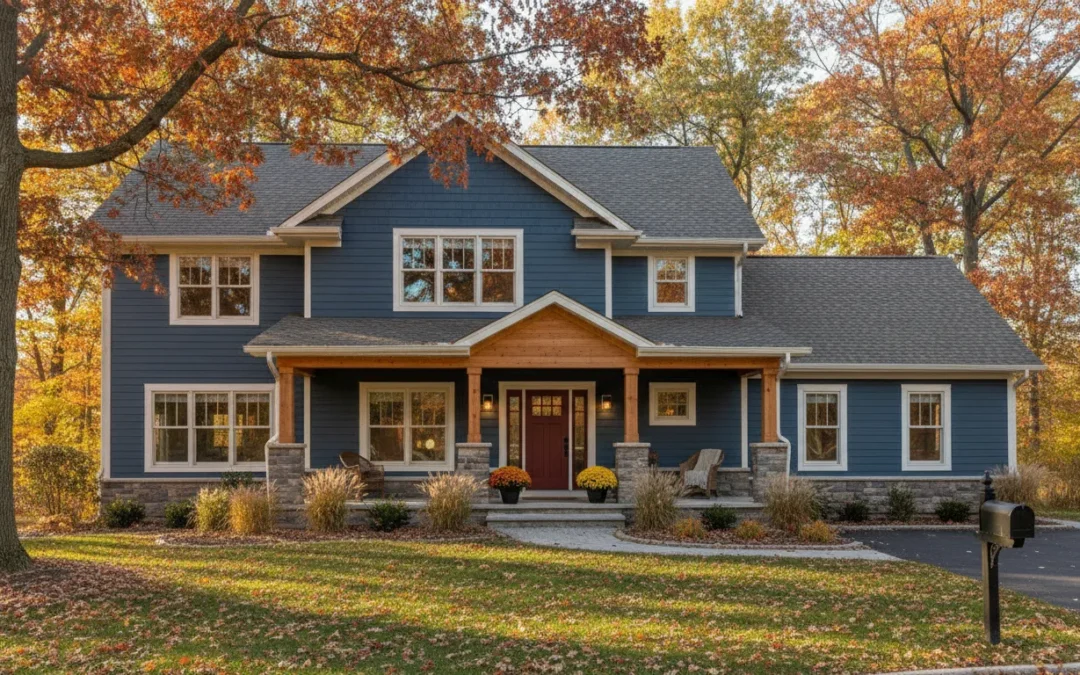
Michigan homes work hard through deep freezes, spring thaw, summer heat, and wind-driven rain. When siding, windows, or doors begin to age, the problem is rarely limited to appearance. Gaps, worn seals, and outdated materials can allow moisture and drafts to move through the exterior, making rooms less comfortable and repairs more complicated.
Siding replacement michigan projects are most effective when treated as a complete exterior upgrade: choose siding that manages moisture and maintenance. Pair it with properly fitted energy-efficient windows, and seal entry doors to improve comfort and protect the home. Michigan’s 2021 residential energy code analysis estimates 10.7% statewide energy savings and $327 in annual utility savings for the average household compared with the prior code. Underscoring the value of a tighter, better-performing envelope. Review the Michigan energy analysis.
The right scope depends on your home’s age, current exterior condition, insulation, and budget. Understanding what is driving these upgrades is the best place to start, especially as Michigan homeowners weigh durability, energy performance, and long-term maintenance.
Siding Replacement Michigan: Why Michigan Homeowners Are Upgrading Their Siding and Windows
Michigan puts more stress on a home exterior than many parts of the country. Winter cold, spring thaws, summer heat, and repeated swings between freezing and above-freezing temperatures cause materials to expand and contract. Over time, that movement can expose gaps, worsen drafts, loosen trim, and allow moisture to reach areas that should stay protected. Siding and windows are not just cosmetic features in this climate. They are important parts of the home’s weather barrier.
Freeze-thaw cycles expose weak points
When moisture finds a small opening behind aging siding or around an older window, freezing temperatures can make the problem worse. Ice expands, the opening becomes more vulnerable, and the next thaw can send water farther into the exterior assembly. Homeowners may notice peeling finishes, soft trim, drafts, condensation, or uneven temperatures indoors before they see obvious structural damage.
Replacing siding and windows gives homeowners an opportunity to address these weak points as part of one exterior project. Proper installation, flashing, and detailing around openings matter just as much as the visible products. The goal is a more dependable envelope that can handle Michigan’s seasonal changes.
Aging homes need envelope updates
Many Michigan homes were built decades ago, when insulation levels, window technology, and air-sealing practices were different from today’s standards. A Kalamazoo retrofit case study from the U.S. Department of Energy documented a 1946 kit home receiving new insulation and siding along with low-emissivity storm windows. The project illustrates why exterior upgrades are often most effective when considered together rather than as isolated cosmetic replacements. Read the Kalamazoo retrofit case study.
Efficiency is becoming a practical priority
Rising utility costs also make energy performance a more important part of renovation decisions. The ResStock data for Michigan identifies approximately $2.3 billion per year in potential utility bill savings from energy-efficiency improvements across the state’s existing housing stock. That figure is a statewide potential, not a promise of individual savings, but it shows the scale of opportunity in improving older homes. Review Michigan’s ResStock housing data.
For an individual homeowner, the right project depends on the home’s age, existing insulation, window condition, ventilation, and visible moisture issues. A professional evaluation can help determine whether siding, windows, or both should be prioritized, and whether the work should be coordinated to create a more complete exterior improvement.
Siding Replacement Costs in Michigan by Material
Material is one of the biggest drivers of a siding replacement estimate, but it isn’t the only one. Your home’s exterior square footage, number of stories, trim details, access, and the cost of removing old siding can all change the final price. The figures below are useful planning ranges, not a substitute for an on-site estimate.
Typical installed costs by siding material
Published ProMatcher estimates place installed vinyl siding at an average of $3.46 per square foot, with a reported range of $2.83 to $4.09. Fiber cement averages about $4.31 per square foot installed, with a range of $3.93 to $4.68. Wood siding averages approximately $4.84 per square foot, ranging from $4.44 to $5.24. Actual bids can vary by region, product line, tear-off requirements, and the complexity of your home’s exterior.
Other Michigan contractor estimates can be substantially higher when they reflect premium products, extensive preparation, or a different pricing method. Lakefront Exteriors lists estimated project ranges of $7,000 to $10,000 for 1,000 square feet. $12,600 to $18,000 for 1,800 square feet. And $15,400 to $22,000 for 2,200 square feet. Peak Home Exteriors lists installed vinyl at $17 to $19 per square foot and Hardie fiber cement at $31 to $36 per square foot. These differences are a good reminder to confirm what each estimate includes, such as removal, flashing, house wrap, trim, permits, and cleanup. Lakefront’s siding replacement cost examples provide additional context for how home size affects a project budget.
What changes the price beyond the material?
Michigan’s freeze-thaw cycles make moisture control especially important. Properly installed siding helps keep water away from the wood structure, while sound flashing and ventilation allow the wall assembly to manage moisture. If the inspection finds rot, damaged sheathing, or inadequate weather protection beneath the old siding, those repairs should be included before the new exterior goes on.
Insulated siding adds a thermal barrier that can help limit thermal bridging. It may cost more upfront than standard vinyl, but it can be worth considering for rooms with cold exterior walls or noticeable temperature differences. Finish and warranty choices matter, too. CertainTeed siding options include PermaColor Lifetime Fade Protection, which helps protect the appearance of the finish over time.
When comparing proposals, look beyond the per-square-foot number. Ask for the product specification, tear-off and disposal costs, substrate repairs, insulation or weather barrier details, trim, and workmanship coverage. You can review available options on our siding services page, or compare fiber cement considerations in our Hardie Board siding guide.
Best Siding Materials for Michigan’s Climate
Michigan siding has to handle freezing temperatures, summer heat, wind, moisture, and repeated freeze-thaw cycles. The best material depends on your home’s existing structure, desired appearance, maintenance preferences, and budget. A professional inspection can also identify whether ventilation or moisture management should be addressed before new siding is installed.
| Material | Typical cost per sq. ft. | Expected lifespan | Durability | Insulation value | Maintenance | Appearance |
|---|---|---|---|---|---|---|
| Vinyl | About $3.46 | 60+ years | Durable and low-maintenance; quality systems can be selected for high-wind performance | Standard vinyl offers limited insulation; insulated vinyl adds a thermal barrier and helps reduce thermal bridging | Low; wash periodically and inspect after severe weather | Wide range of colors, profiles, cedar shake, and board-and-batten styles |
| Fiber cement | About $4.31 | Often several decades with proper care | Resists fire and insects and provides a substantial, rigid finish | Moderate; usually paired with other insulation and air-sealing improvements | Moderate; maintain paint or finish and keep joints properly sealed | Wood-look lap, shake, and vertical profiles with a refined, traditional feel |
| Engineered wood | Varies by product and installation | Varies by product and maintenance | Designed for dimensional stability and a wood appearance, but still needs moisture control | Moderate; performance depends on the product and wall assembly | Moderate; inspect finish, seams, and areas exposed to moisture | Natural wood appearance in lap, shake, and vertical profiles |
| Cedar shake | Varies by product and installation | Varies with exposure and upkeep | Attractive and weather-capable when properly installed and maintained | Limited by itself; combine with proper wall insulation and air sealing | Moderate to high; finish and moisture conditions need regular attention | Distinctive textured look that adds character to traditional and cottage-style homes |
| Board-and-batten | Varies by material and installation | Follows the selected siding material | Performance depends on the underlying vinyl, fiber cement, or engineered wood system | Depends on the siding system and wall assembly | Depends on the selected material; check vertical seams and trim | Bold vertical lines that work well as a full exterior or an accent |
What to look for in a Michigan siding system
Product details matter as much as the broad material category. CertainTeed PermaColor siding includes Lifetime Fade Protection, helping the chosen color stay consistent over time. CertainTeed options are also available with wind resistance rated up to 200 mph, which can be important for exposed homes and severe-weather concerns.
Moisture management deserves equal attention. F10 ventilated siding allows air movement and moisture escape behind the siding, helping prevent condensation buildup that can contribute to mold. Insulated vinyl can add another thermal layer, while correct flashing, trim, and installation protect the wall assembly from water intrusion.
Vinyl is often the practical choice for homeowners who want long service life and minimal upkeep. Fiber cement suits homeowners who prioritize a heavier, wood-like appearance and added fire and insect resistance. Cedar shake and board-and-batten provide more distinctive design options, and Signature Home Pros can help match the material and profile to your home’s architecture.
How Much Do Replacement Windows Cost in Michigan
For Michigan homeowners planning a window project in 2026, a realistic starting range is about $400 to $1,250 per window installed, according to Koalaty Windows’ 2026 cost data. Your final estimate will depend on the window style, frame material, glass package, installation conditions, and whether the existing units need extra repair or disposal.
Typical installed prices by window style
Window style has a noticeable effect on both the product and labor cost. Double-hung windows are often the most budget-friendly choice, ranging from $400 to $1,150 each installed. Casement windows commonly run $600 to $1,350 because their operating hardware and design differ from a standard double-hung unit. Sliding windows typically cost $550 to $1,200.
Bay and bow windows are a larger investment because they project from the wall and may require more involved installation. Expect approximately $3,500 to $9,000 or more for a bay or bow window project. Structural adjustments, interior trim, and custom sizing can move that number higher.
How frame material and glass change the estimate
Vinyl windows generally cost $400 to $900 per window and are popular for their low maintenance and practical price point. Fiberglass units typically range from $900 to $1,600, while composite windows commonly fall between $850 and $1,500. The right choice depends on your priorities for appearance, durability, maintenance, and budget, not just the initial number.
For perspective, replacing 15 windows throughout an average home may total about $6,000 to $18,750. Triple-pane glass can add roughly $150 to $350 per window. That upgrade may be worth considering for homes near busy roads or rooms where outside noise is a concern. As Koalaty’s data indicates triple-pane windows can reduce noise by about 50%.
What to include in a Michigan window estimate
A useful quote should identify the window style, frame material, glass configuration, removal and disposal, trim work, flashing, and installation warranty. It should also account for Michigan’s seasonal conditions and the condition of the opening, rather than treating every replacement as a simple product swap. Alliance Window Systems is one of Signature Home Pros’ window partners, and ThermaTru entry doors can be considered when a broader exterior update makes sense.
To review the available options, visit our window and door replacement services. Signature Home Pros provides straightforward guidance and no-pressure estimates, so you can compare the scope of work before deciding how to move forward.
Energy Savings from New Siding and Windows in Michigan
Your home’s exterior is more than a visual finish. Siding, insulation, windows, and the surrounding air seals work together as a building envelope. When that envelope has gaps, weak insulation, or outdated glass, your heating and cooling system has to work harder to maintain a comfortable indoor temperature.
Insulated siding helps limit thermal bridging
New siding with insulated backing adds a continuous thermal layer over the outside of the home. That layer can reduce thermal bridging, which occurs when heat moves more easily through framing, fasteners, or other less-insulated areas. In winter, reducing those pathways helps limit heat loss through the walls. In summer, it can help slow unwanted heat gain.
Insulated siding is not a substitute for a complete insulation assessment, but it can be an important part of an exterior upgrade. A contractor should evaluate the existing wall assembly, moisture management, and ventilation before recommending the right siding system.
Replacement windows reduce heat transfer and drafts
Energy-efficient windows reduce heat transfer through the glass, helping rooms stay warmer in winter and more comfortable year-round. This matters especially in older Michigan homes with single-pane units or worn seals. Koalaty reports that single-pane homes can lose 25% to 30% of their heat through the glass. While the average Michigan homeowner may save approximately $300 to $550 per year by switching to ENERGY STAR double-pane windows.
New windows also address air leakage. When siding and window replacement are completed together, the installer can integrate the window flashing and exterior cladding into a tighter envelope. That coordinated approach helps eliminate drafty spots and uneven room temperatures.
A tighter envelope can reduce HVAC demand
When less heated or cooled air escapes, your HVAC equipment does not need to run as frequently to maintain the thermostat setting. The potential impact is meaningful across Michigan’s housing stock. The U.S. Department of Energy’s 2021 analysis estimated that the updated residential energy code could produce 10.7% statewide energy savings. Equal to about $327 in annual utility savings for the average Michigan household: review the Michigan residential energy-code analysis.
Actual results depend on insulation levels, home size, equipment efficiency, installation quality, and occupant habits. A whole-envelope evaluation, including our roofing services, can help identify where air sealing and exterior improvements will deliver the most value.
Michigan Rebates, Tax Credits, and Financing Options
Exterior improvements may qualify for more than one type of financial assistance, so check every option before you finalize your project. For eligible Energy Star Most Efficient windows, the federal 25C tax credit can cover 30% of product cost, up to $600 per year. Keep your receipts and confirm current eligibility requirements with a tax professional before filing.
Utility programs can provide additional help. DTE Energy offers a $15 rebate per qualifying window, while Consumers Energy lists rebates of $15 per window and $40 per patio door. Program rules, eligible products, documentation, and funding can change, so verify the details with your utility before ordering materials.
Statewide programs for whole-home improvements
Michigan homeowners may also want to review MiHER programs administered through the Michigan Department of Environment, Great Lakes, and Energy. The HOMES program has $105.7 million available for whole-home efficiency upgrades, including insulation, air sealing, and building-envelope improvements. These upgrades can complement new siding and windows by addressing heat loss beyond the visible exterior.
Loans and project financing
For homeowners who want to spread out the investment, Michigan Saves offers low-interest financing, with rates starting at approximately 5.99% APR. Availability and terms depend on the participating lender and project qualifications. Ask for the current rate and repayment details rather than relying on an old estimate.
Signature Home Pros also offers promotional financing with no interest and no payments until 2027, subject to program terms and approval. Because incentives may be stackable, a qualifying project could combine a tax credit, utility rebate, state program assistance, and financing. Our team can help you identify which questions to ask and prepare a clear estimate, without pressure, so you can compare the full project cost with potential savings.
Why Bundle Siding, Windows, and Doors in One Project
Replacing several exterior components at once can make a major renovation easier to manage. Instead of coordinating separate siding, window, and door contractors, you have one team planning the work, communicating the schedule, and taking responsibility for the finished exterior.
One plan, fewer scheduling headaches
Exterior projects overlap. Window and door openings need to be integrated with the siding, and the order of installation matters for weather protection and clean finish work. A single contractor can coordinate these steps instead of asking you to manage multiple crews, arrival dates, and handoffs. One project plan also makes it easier to keep the home’s colors, trim, flashing, and exterior details visually consistent.
Combined work can improve comfort
Siding, windows, and doors work together as part of your home’s exterior envelope. Replacing them as a coordinated system can create a more air-tight seal around openings and wall surfaces, helping eliminate drafts and uneven room temperatures. It also gives the installation team a better opportunity to address gaps or transition points while the exterior is open.
One contractor for the full exterior
Bundling may also reduce duplicated labor, setup time, and return trips. Rather than paying separate companies to mobilize and work around one another, you can discuss the complete scope with one project team. Warranty questions are simpler, too: you’ll have one primary point of contact to help clarify which products and installation work are covered. Always review the written warranty terms before approving the project.
Signature Home Pros offers all five exterior services under one roof: roofing, siding, gutters, windows and doors, and stone installation. That single-source approach is a meaningful difference from contractors who handle only one portion of the renovation. You can explore our home exterior renovation services and decide which improvements make sense together.
Our process is built around no-pressure conversations and free estimates. We’ll review your home’s needs, explain practical options, and provide a clear scope so you can decide on your timeline with confidence.
Frequently Asked Questions
How much does siding replacement cost in Michigan?
A full replacement commonly falls in a broad range because home size, material, tear-off, repairs, trim, and access all affect the estimate. One Michigan search benchmark places a typical two-story replacement around $8,250 to $20,000, but it should not replace a project-specific quote. Ask for a written scope that identifies the siding system, insulation, moisture repairs, disposal, and finishing details included.
What is the best siding material for Michigan homes?
There is no single best choice for every home. Vinyl is a practical, low-maintenance option for Michigan’s temperature swings, while insulated vinyl can add a thermal barrier. Fiber cement offers a wood-like appearance with resistance to fire and insects. Your budget, preferred appearance, maintenance expectations, and the home’s existing wall condition should guide the decision.
When will new siding and windows start saving energy?
You’ll usually notice comfort improvements as soon as the work is complete, especially in rooms affected by drafts or cold glass. Actual utility savings depend on air leakage, insulation, household habits, weather, and the condition of the old materials. Energy-efficient windows reduce heat transfer, and coordinating window installation with siding can help create a more consistent exterior seal.
Is it worth bundling siding, windows, and doors?
Bundling can simplify a project when several parts of the exterior are aging at the same time. One coordinated crew can plan flashing, trim, transitions, and air sealing together instead of making you manage multiple schedules. It may also reduce duplicated disruption. Compare the complete scope, warranties, materials, and installation details rather than choosing a bundle on price alone.
What financing options are available for exterior improvements?
Financing depends on approval and the current program terms. Signature Home Pros advertises financing with no interest and no payments until 2027, subject to applicable terms. You can also ask whether utility rebates, tax credits, or other Michigan programs fit your window or door project. Confirm eligibility, deadlines, total repayment, and promotional-period terms before signing.
Schedule Your Michigan Exterior Consultation
Every home has different needs, from drafty windows to siding that has weathered years of Michigan seasons. A free consultation can help you compare practical options for your exterior and plan the work with less guesswork. When you’re ready, call 810-270-5922 to schedule a free consultation and estimate with Signature Home Pros. Our team can listen to your goals and outline the next steps for your siding, windows, or doors.
Recent Comments