
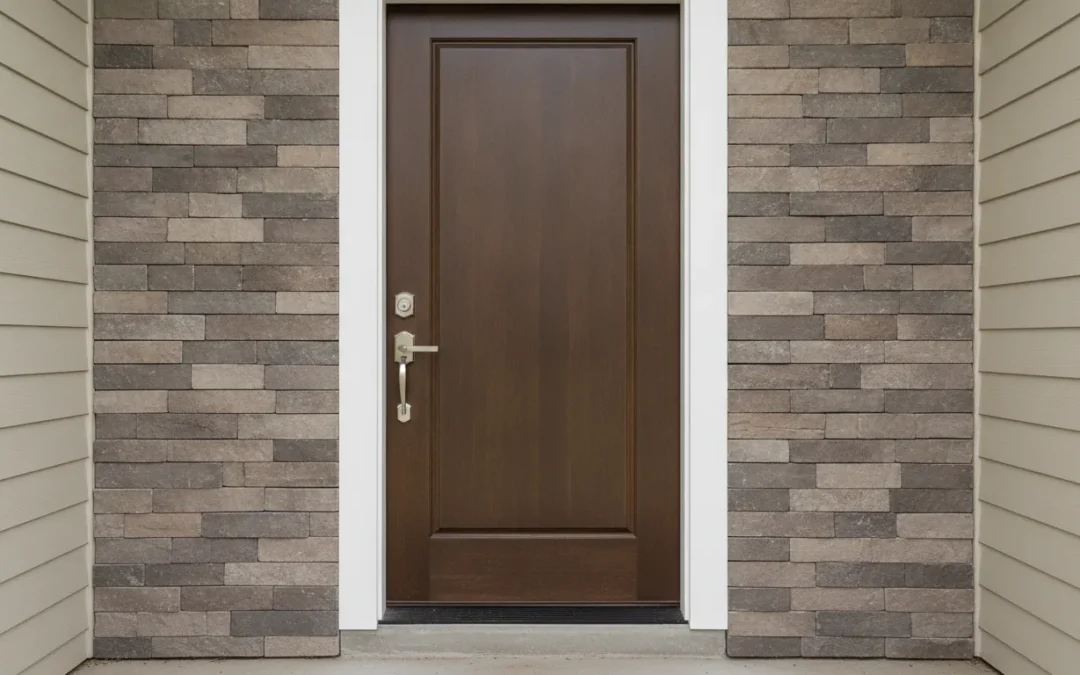
Stone accents for home exterior projects work best as a limited frame, not a second full facade. A surround at the front door, a band along the lower front wall, or stone on porch columns can add weight and character. Covering every wall usually fights the siding, the roof, and the entry instead of supporting them.
The useful question is where the stone starts and where it stops. Decide that line before you pick a color. A clear stop point keeps the accent looking planned. A vague “some stone on the front” often turns into an awkward patch that ends at a random stud or window.
Schedule a free stone consultation
Where Stone Accents for Home Exterior Projects Belong
Start with the front elevation you already have. The door, the porch, the garage, the roof slope, and the siding are the fixed pieces. Stone should reinforce one of those pieces. It should not introduce a new focal point that ignores them.
Five placements cover most Mid-Michigan homes. Each one answers a different design problem. None of them requires wrapping the whole house.
| Placement | What it frames | Works best when | Watch for |
|---|---|---|---|
| Entry surround. | The front door and the wall beside it. | The door is the main focal point and the porch is simple. | A surround that stops mid-window or dies into a corner with no trim. |
| Porch columns. | The porch roof and the walk to the door. | Columns already carry visual weight, or a plain porch feels light. | Stone on one column only, or a base wider than the porch pad. |
| Lower front band. | The bottom of the front wall, often called a wainscot. | You want weight at grade without changing the upper siding. | A band that ends at a random height, or one that skips the garage. |
| Garage face. | The wall beside or above the garage door. | The garage dominates the street view and the entry feels small. | Stone that makes the garage louder than the front door. |
| Chimney or front gable. | A vertical feature already on the elevation. | A chimney or gable is visible from the street and looks unfinished. | Stone that climbs past the roof edge with no planned cap or stop. |
Pick one primary placement. A second, smaller accent can support it. Three competing accents usually look accidental. If the entry and the garage both want attention, give the entry the stronger treatment and keep the garage quieter.
Signature Home Pros installs exterior and interior stone from its Flushing shop, including entry accents, facades, and smaller decorative areas. The stone installation ideas page is the place to talk through which of those areas fits the house you have.
How Far the Accent Should Extend
Proportion is the part homeowners skip, and it is the part neighbors notice. Stone that is too short looks like a patch. Stone that runs too far starts to look like a full veneer job that ran out of material.
Use the architecture you can already see:
- Stop the stone at a corner, a window trim line, a porch beam, or the edge of a roof overhang. Those are real lines. A stud bay is not.
- On an entry surround, carry the stone at least to the outer edge of the sidelight or trim, then end on a finished return. Do not stop in the middle of a blank wall.
- On a lower band, choose a height you can explain. Common stops are the windowsill line or a height that clears splash from the ground. Keep that height the same across the front.
- On columns, stone should read as the full column or a deliberate base. A thin wrap that ends halfway up the post looks unfinished.
- On a gable, stop at the roof edge or at a horizontal trim line. Do not let stone climb into the rake with no cap.
Walk across the street before you approve a sketch. From the curb, the accent should explain itself in one glance. If you have to point at it and say “the stone is only on this part,” the line is probably wrong.
Michigan freeze and thaw, plus roof runoff, make the bottom of the wall a design issue too. Keep the accent out of constant splash and out of soil that piles against the wall. Manufactured stone veneer performs when the detailing and construction are right, not when the finish is simply stuck on the wall. The Concrete Masonry and Hardscapes Association says as much in its manufactured stone veneer installation guide. The guide is written for installers. The lesson for a homeowner is simple. The edge, the base, and the flashing are part of the design.
Match the Accent to Siding, Roof, and the Entry
Stone is one material in a set. The siding, the roof, the trim, and the front door are already chosen or about to be. The accent should sit with them, not overpower them.
Look at color in daylight, not under a showroom lamp. A busy, high-contrast stone next to a busy siding pattern makes the front feel noisy. A quieter stone can carry a larger area. A stronger stone usually belongs in a smaller frame, such as the entry or the columns.
Roof color matters as much as siding color. A dark roof can handle a deeper stone. A light roof often looks better with a stone that stays in the same warm or cool family as the trim. You do not need a perfect match. You need the three large surfaces, roof, siding, and stone, to feel like one house.
The front door should stay readable. If the stone is darker than the door and wraps it tightly, the door can disappear. Leave a clean trim or a lighter border so the entry still reads as the way in. If the door itself is due for replacement, plan that finish with the stone instead of after it. Signature Home Pros also replaces entry doors, so the two scopes can be discussed in one visit rather than as two separate projects that never meet.
If siding is part of the same season of work, decide the transition before either crew starts. A siding replacement plan should name where the stone begins so the siding does not get cut back later. Comparing siding options for Michigan homes beside a stone sample is more useful than picking the siding color alone.
What Changes the Scope Before Anyone Installs
A small accent is still a wall project. The visible area can be modest while the preparation is not. These are the conditions that change the conversation, and none of them can be settled from a photo alone.
- What is behind the wall. Framed walls, masonry, and older additions do not take the same preparation. The installer has to see the surface.
- Openings and corners. Every window, door, and outside corner in the accent area needs a finished edge. More corners mean more layout, even when the square footage looks small.
- Height and access. A gable or a tall entry is a different job from a band you can reach from the ground.
- Water at the base and the top. Gutters, downspouts, and the soil line decide whether the bottom of the accent stays dry. A gutter system that dumps water onto the new stone is a design problem, not a stone problem.
- Other work in the same area. New siding, a new entry door, or porch repairs should be sequenced so the stone edge has something finished to meet.
Do not treat a mood-board photo as a scope. Photos hide the return at the corner and the flashing over the window. Bring the photo as a goal. Let the measured wall decide what is buildable.
If you want the material comparison, or you are still deciding between a veneer face and brick, use the existing guide rather than mixing that decision into the layout. The exterior stone veneer guide covers what the facing is and how the wall behind it is supposed to manage moisture. This article assumes you already want a limited accent and need to place it.
A Simple Order for Planning the Accent
You can do the design thinking before anyone measures. This order keeps the consultation short and specific.
- Stand at the curb and name the one feature that should get stone. Entry, columns, lower band, garage, or chimney.
- Mark the start and stop with painter’s tape or a photo with lines drawn on it. Use a corner, a trim line, or a roof edge as the boundary.
- Set the stone next to a siding sample, a roof shingle, and the front door color in daylight. Reject the combination if one surface shouts.
- Note water. Where do downspouts land? Does soil or mulch touch the wall? Does the porch roof dump rain at the entry?
- List the other work. Siding, door, porch, or gutter changes belong in the same note so the edges are planned once.
- Bring that packet to the consultation: photos from the street, the tape or sketch, and the samples you are keeping.
Signature Home Pros is a family-owned exterior company in Flushing. The team handles roofing, siding, gutters, windows and doors, and stone, so an accent does not have to be coordinated across several contractors. The sales visit is a consultation, not a high-pressure pitch. You should leave with a clear scope, or with a reason the placement you wanted will not work on that wall.
What to Bring to the Consultation
A useful visit starts with the house, not a catalog. These items let the conversation stay on your elevation:
- Three photos: from the street, straight on at the front door, and a close shot of the wall you want to accent.
- The stop line you prefer, marked or sketched.
- One siding sample or a clear photo of the existing siding, plus the roof color.
- Notes on any soft spots, prior patches, or additions along that wall.
- A yes or no on whether siding, the entry door, or gutters are in the same project.
Ask where the stone will end, how the edge will be finished, and how water will be kept off the top and the base. Ask which product is being proposed for an exterior wall, and ask to see that product’s information rather than a similar sample. Those questions are about your house. They are not a quiz on installation technique.
Pricing depends on the measured area, the corners, the height, and the wall condition. There is no single accent figure. If budget is the open question, the cost article is the right next read, and a measured visit is the right way to get a number. The stone veneer installation cost guide explains which factors move an estimate. It does not replace a look at your wall.
Service is based in Flushing, with work across Genesee County and nearby communities including Flint, Grand Blanc, Fenton, Davison, Linden, and Swartz Creek. A Grand Ledge location covers the west side of that Mid-Michigan area. If the house is outside the area the team serves, say so early.
Request a free estimate for your entry or accent
Frequently Asked Questions
Can I add stone accents without redoing the whole exterior?
Yes. A surround, a column wrap, or a lower band is a limited scope. The wall behind that area still has to be suitable, and the edge has to end on a real architectural line. The rest of the siding can stay.
Should the stone match the siding exactly?
No. Exact matches usually look flat. The stone, siding, and roof should sit in the same color family, with one of them a little stronger. The front door should still be easy to see.
Is a lower band better than an entry surround?
Use a lower band when you want weight along the front and the door is already clear. Use a surround when the door is the feature and the rest of the wall should stay quiet. Doing both can work if the band is calm and the surround is the accent.
Will Michigan weather change where I should put the accent?
It changes the base and the top more than the style. Keep stone out of soil and heavy splash, and plan the edge so water from the roof and gutters is directed away. Placement on a wet, shaded entry needs that review before the look is approved.
Who should I talk to about the scope?
Talk to the company that will install it, with photos and a stop line in hand. Signature Home Pros can review exterior stone accents alongside siding, gutters, and the entry door from its Flushing team. Call (810) 270-5922 or use the contact form to set a consultation.
Recent Comments