
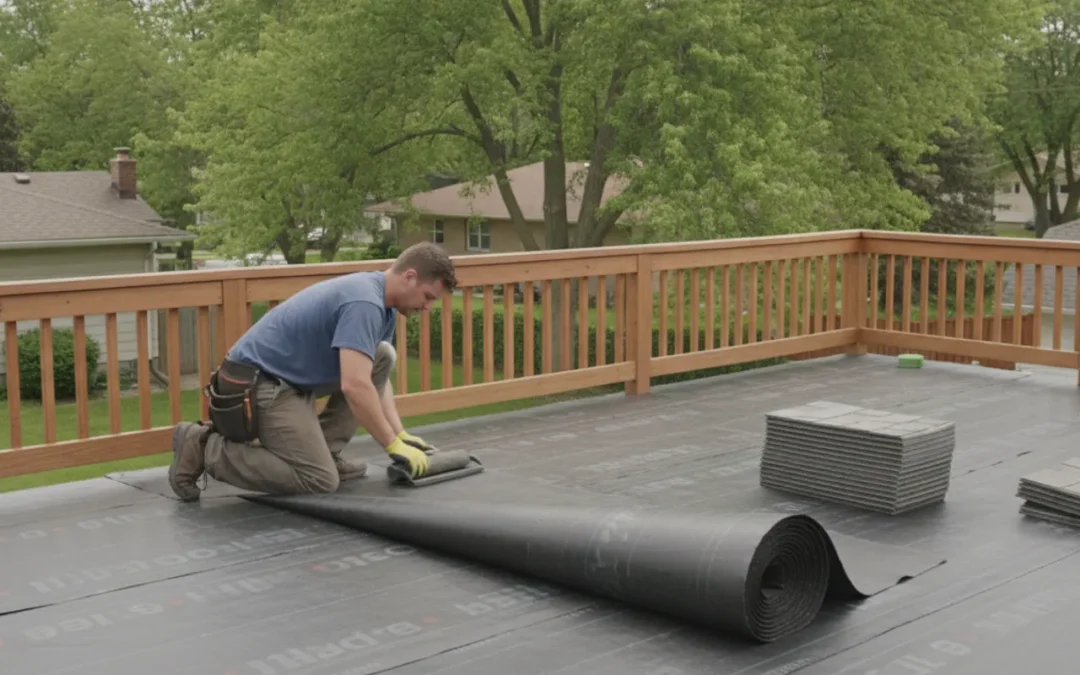
Roof underlayment is a protective layer installed between the roof deck and the outer roofing material. For Michigan homeowners, understanding this hidden part of a roof system can make a replacement estimate easier to evaluate. It is not a substitute for shingles, flashing, or sound installation, but it plays an important supporting role.
For a wider view of the roof replacement process, start with our roofing service information. This guide focuses specifically on underlayment: what it does, how common options differ, and what to clarify before work begins.
What does roof underlayment do?
Underlayment is placed over the roof deck and beneath shingles or another roof covering. It provides a secondary layer of protection if water gets past the outer surface. It can also help protect the deck during the roofing project, depending on the product and conditions.
The roof covering remains the primary defense against weather. Roof design, flashing at transitions, ventilation, and correct installation all matter too. Underlayment cannot correct a damaged deck or make poorly detailed edges and penetrations reliable by itself.
Think of a roof as a system of overlapping parts. Shingles shed most water; flashing directs water around joints and openings; underlayment covers the deck below. If you are comparing a full project, our roof replacement homeowner guide provides broader planning context.
Which types of roof underlayment are common?
Products vary by material, surface, fastening approach, and the roofing system they are intended to support. The names below describe broad categories, not a universal ranking. A contractor should identify the actual product and explain why it suits the roof design and covering.
| Type | General characteristics | Questions to ask |
|---|---|---|
| Asphalt-saturated felt | A traditional roll product used beneath many roof coverings. Product weight and specifications vary. | Which grade is specified, and is it compatible with the planned roof covering? |
| Synthetic underlayment | A manufactured sheet product. Specific strength, surface, and exposure guidance depend on its product data. | What product is included, and what installation and exposure limits apply? |
| Self-adhered membrane | An adhesive-backed membrane used in selected roof areas or applications, subject to roof design and product requirements. | Where will it be used, and how will it integrate with edges, valleys, and other details? |
These categories should not be treated as interchangeable based on a label alone. Read the product documentation and confirm it is suitable for the roof covering, deck, and planned installation. When comparing roof materials, our guide to roofing materials for Michigan homes can help you frame the wider system discussion.
How can Michigan conditions affect the decision?
Michigan roofs experience changing seasons, wind-driven rain, snow, and freeze-thaw cycles. Those conditions make water management and sound detailing important, but they do not mean every roof needs the same underlayment configuration. Roof slope, valleys, eaves, penetrations, the existing deck, and the selected covering all affect the plan.
Ask how the proposed product and installation align with the roof system manufacturer’s instructions and applicable local requirements. For background on roof-related weather considerations, see our Michigan ice dam prevention guide. It covers a related concern without replacing the need for a project-specific assessment.
Seasonal conditions also affect planning conversations. A roof may be opened during a period when rain or snow is possible, so ask how the work sequence accounts for changing weather. The answer should address the actual product, the roof area being worked on, and the contractor’s plan for keeping the structure protected as the project progresses. Avoid relying on a generic promise that every material has the same weather tolerance.
What should you check in an estimate?
A useful estimate should make clear what is included rather than relying on a generic phrase such as new underlayment. Review these items before approving the scope:
- Product identification: Ask for the manufacturer’s name and product or type, along with its intended use.
- Coverage: Confirm whether the scope describes full-deck coverage or identifies specific areas for different materials.
- Roof details: Ask how valleys, eaves, penetrations, and transitions are handled in the proposed system.
- Deck condition: Clarify how concealed or damaged decking will be addressed if found, and how any change in scope will be discussed.
- Installation basis: Ask whether installation follows product directions and the selected roof covering’s requirements.
- Written scope: Make sure the estimate distinguishes included work from allowances or items that require separate approval.
These questions help you compare like with like. Two estimates may use similar terms but describe different products or coverage. For more planning questions, consult our questions to ask before hiring a roofer.
How do roof details influence underlayment choices?
Not every part of a roof has the same shape or exposure. A broad, uninterrupted roof plane differs from a valley where two slopes meet, or an eave where the roof edge meets gutters. The appropriate product and coverage can vary by location, so a useful estimate should avoid treating the entire roof as an unexplained single line item.
Ask the contractor to identify any areas where the proposed system uses a different material or additional layer. A clear answer should connect the choice to the roof layout, the planned covering, and applicable product directions. If a contractor describes a special treatment, ask which area it applies to and whether it is included in the written scope.
Also ask how penetrations such as vents and skylights are addressed. Underlayment is only one part of these transitions; flashing and the surrounding roof materials also have to fit together. Homeowners should not infer from a product name alone that every junction has been handled. The scope should explain the system at a level you can understand without requiring you to direct the installation.
Edges deserve the same attention as the middle of the roof. Eaves, rakes, walls, chimneys, valleys, and roof-to-wall transitions each present a place where layers meet. You do not need to prescribe a particular detail, but you can ask for a plain-language description of how the proposed system manages water at those locations. If the answer only names the roll material and says nothing about transitions, request a more complete scope.
How can you compare two estimates fairly?
Put the proposals side by side and compare the details, not just the totals or labels. Note the underlayment product or category, coverage, any areas receiving a different material, and whether the proposed work is tied to the selected roof covering. If one proposal is vague, ask for clarification before treating it as equivalent to a more specific estimate.
Use a simple checklist:
- Write down the stated underlayment product for each proposal.
- Mark whether coverage and roof areas are described clearly.
- Check that both proposals refer to the same general roof scope and covering.
- Identify exclusions, allowances, and possible deck-related changes.
- Ask each company the same follow-up questions and compare the clarity of the answers.
This method does not tell you which proposal is best, but it reduces the chance of comparing different scopes as though they were identical. It also gives you a record of what was explained before you make a decision.
For example, one estimate might list a named synthetic product across the deck and identify a separate membrane at selected details. Another might list only underlayment with no product, coverage, or detail information. The lower total is not automatically a better value if the two scopes are not equivalent. Ask both companies to state their assumptions in writing, then compare the revised descriptions rather than trying to decode an unexplained allowance.
It can help to make a comparison sheet with one row for the roof covering, one for deck preparation, one for underlayment, one for flashing and transitions, and one for exclusions. Add the same questions to each proposal. This keeps a familiar product name from receiving more weight than the actual scope. It also makes it easier to notice when one estimate includes work that another leaves conditional.
How should the underlayment fit the roofing material?
Start with the planned roof covering rather than selecting underlayment in isolation. Asphalt shingles, metal panels, and other coverings can have different system requirements. The roof covering manufacturer may specify compatible underlayment types, installation details, or limitations. Ask the estimator to name the covering and underlayment together, then explain how the two products are meant to work as a system.
Compatibility is more than whether a product can physically sit beneath another layer. Product directions may address the roof slope, deck surface, fastening method, exposure time, and whether materials can be combined. If an estimate uses a broad category name, ask for the product label or data sheet before assuming its properties. You do not need to interpret every technical specification yourself; the useful outcome is a clear explanation of the specified product and its intended application.
Changes to the roof covering can affect other parts of the plan as well. If you are still considering options, compare the complete proposed assembly, including edge and penetration details, rather than choosing solely by appearance or a product name. Our overview of metal roof panels discusses another roof covering type and can help you prepare broader system questions.
What should you clarify about exposure and installation timing?
Underlayment may be exposed between the time it is installed and the time the outer roof covering is completed. Products differ in their stated exposure limits and handling instructions, so there is no universal number of days that applies to every material. Ask which product is specified, what its manufacturer says about exposure, and how the project plan accounts for weather and scheduling.
This is a practical scope question, not a reason to assume that a short delay means a defect. The answer should be tied to the actual product information and project conditions. If weather changes the schedule, ask how the exposed area will be managed and who will communicate any change in the work sequence. Clear communication helps you know what to expect without attempting to supervise technical installation.
Ask also whether the estimate identifies the underlayment work separately from the roof covering and related details. A written scope should make clear what is included, what is conditional on what is found after materials are removed, and how any proposed change will be discussed. Keep the revised scope or written confirmation with the original estimate so you can see what changed and why.
Before the project begins, ask where questions should go if the schedule changes. You may want to know who will explain a weather-related pause, how a newly exposed area will be protected, and when you will receive an updated timeline. These are communication questions rather than instructions for a particular installation technique. A clear answer can make the project easier to follow while leaving technical decisions to the qualified roofing team.
What happens when the roof deck is exposed?
Underlayment is installed over the roof deck, so the visible condition of the existing roof before tear-off may not tell the whole story about the surface beneath it. A project plan should explain how the contractor will communicate if a concealed issue is discovered. Ask what information you will receive, who will explain the options, and whether approval is needed before extra work proceeds.
It is also reasonable to ask how the deck surface will be prepared for the specified material. Product instructions can address the required substrate and fastening approach. Rather than requesting a particular technical method without context, ask the contractor to confirm that the surface and installation plan meet the product directions and the requirements for the selected roof covering.
These questions are useful because the underlayment layer will be covered later in the project. Before work starts, agree on what communication or documentation will be available while relevant layers are visible. The goal is not to inspect or direct each installation step yourself. It is to understand the written scope and have a clear route for resolving questions if conditions differ from what the estimate anticipated.
When a change is proposed, ask for three pieces of information: what was found, what response is recommended, and how the change affects the scope. You can also ask whether the work can pause while you review the explanation. A clear process protects both sides from confusion and keeps an unexpected deck condition from being treated as an unexplained addition.
What are common misunderstandings about underlayment?
Does underlayment make shingles waterproof?
No. It is a secondary layer beneath the roof covering, not a replacement for the covering, flashing, or proper detailing. The entire assembly must work together.
Does a premium-sounding product name prove better performance?
Not on its own. Compare the specific product information, intended application, installation instructions, and the written scope. Ask the contractor to explain any upgrade in practical terms rather than relying on a label.
Can you judge the underlayment after the roof is finished?
Much of it is concealed once roofing material is installed. That is why the proposal and project communication matter. Keep the written scope and ask what documentation or progress information will be provided.
Should every roof use the same underlayment?
No single choice can be assumed to fit every roof. Roof design, covering, product instructions, and local requirements affect the plan. Ask for the reason behind the specified product and coverage on your home.
Is the most expensive option always necessary?
Not necessarily. A higher price may reflect a different product, broader coverage, or a specific roof detail, but the label alone does not explain the value. Ask what problem the proposed option addresses and whether the complete assembly requires it.
How can you make a confident decision?
Begin with the complete roof plan, not one material name. Confirm which covering is proposed, what underlayment is specified, where different materials will be used, and how important roof details are addressed. Then compare estimates based on equivalent scope and clear product information.
If anything is unclear, ask for a plain-language explanation before signing. A no-pressure discussion can help you understand the options for your home and decide what questions still need answers. For homeowners looking to understand roofing systems more broadly, the National Roofing Contractors Association is a professional resource; product-specific decisions should still be checked against the manufacturer’s instructions and the written project plan.
To review a roof project with Signature Home Pros, learn about roofing services or contact the team. The company is family-owned and serves central Michigan homeowners with a no-pressure approach, so you can bring questions about the roof covering, underlayment, deck condition, and written scope to the conversation.
Understanding the underlayment specification helps you evaluate the whole roof system and know what to clarify before work begins.
Recent Comments